
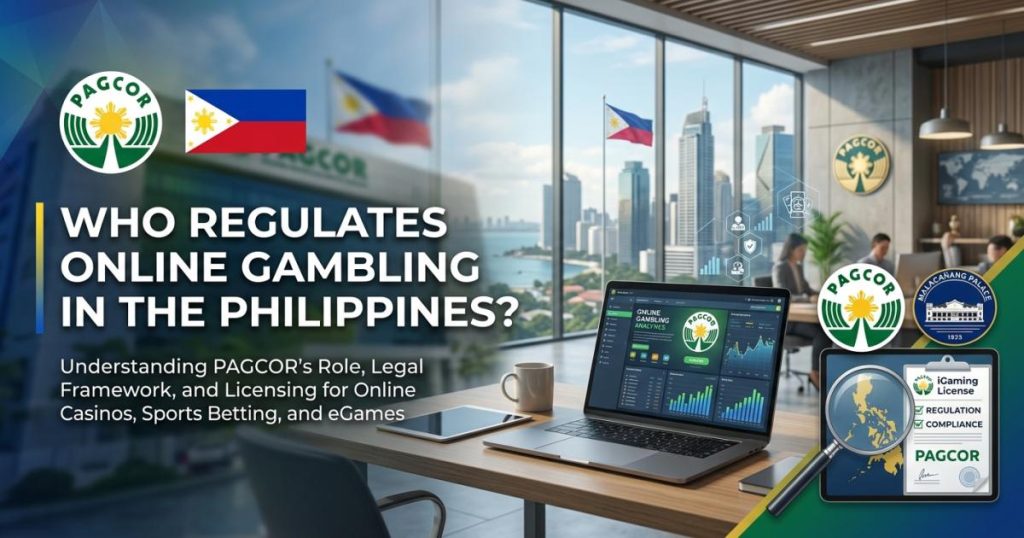
For 21+ players using FBM Play, who regulates online gambling in the Philippines is answered first by PAGCOR, alongside agencies covering payments, money laundering, data, and registration.
This is general information, not legal advice. The roles described below are based on Philippine legal commentary and gaming-law guides available for 2025 and 2026, and they may change if new laws are passed.
The Short Answer
The Philippine Amusement and Gaming Corporation (PAGCOR) is the main regulator. PAGCOR licenses and accredits operators that may offer gambling to players in the Philippines.
In plain terms, PAGCOR licenses and regulates gambling in the Philippines, and the BSP, AMLC, and NPC cover payments, money laundering, and personal data.
Several other agencies cover separate parts of the picture: the Bangko Sentral ng Pilipinas (BSP) covers payment rules for banks and e-wallets; the Anti-Money Laundering Council (AMLC) covers anti-money-laundering rules; the National Privacy Commission (NPC) covers personal data; and the Securities and Exchange Commission (SEC) covers company registration.
A platform that offers online casino games to players in the Philippines without PAGCOR accreditation is not a legal option. Read more about this distinction in online casino legality in the Philippines.
Who Does What
| Agency | What it covers | What it means for a player |
|---|---|---|
| PAGCOR | Licenses and accredits gambling operators, and regulates games of chance. | Check that the operator appears on its accredited list. |
| Bangko Sentral ng Pilipinas (BSP) | Payment rules for banks and e-wallets. | Affects how GCash and Maya connect to gaming sites. |
| Anti-Money Laundering Council (AMLC) | Enforces the Anti-Money Laundering Act. Casinos, including internet-based casinos, have been covered persons since Republic Act No. 10927. | Explains why operators request ID and keep records. |
| National Privacy Commission (NPC) | Enforces the Data Privacy Act of 2012. | Covers rights over personal data and where to raise a privacy complaint. |
| Securities and Exchange Commission (SEC) | Registers companies, including operating companies. | The operator should be a registered company. |
Source basis: Philippine legal commentary and gaming-law guides from Chambers, Respicio & Co., and MyGamingLicense, as described for 2025 and 2026.
PAGCOR: Licensing and Accreditation
PAGCOR is the central regulator for games of chance. According to Philippine gaming-law guides, operators need PAGCOR licensing or accreditation to offer gambling in the Philippines. When people use the phrase online gambling regulators Philippines, PAGCOR is generally the agency they mean for the gambling-operator side.
On PAGCOR’s August 27, 2026 list, FBM Play appears under its operator, Memo Multinational Corp., together with its brands and domain names. The domain fbmplay.com should be checked against the relevant PAGCOR information rather than assumed to represent an accredited operator on its own.
- Check the operator: Review PAGCOR’s accredited list before creating an account or making a payment.
- Compare the details: Match the operator, brand, and domain information shown on the platform.
- Use verification resources: See the FBM Play license status, the PAGCOR verification page, and this legit gaming checklist.
A pagcor regulator reference should be understood as a reference to PAGCOR’s licensing and accreditation role, not as a promise about a particular platform’s service or outcomes.
BSP: Payments
The BSP sets rules for banks and e-wallets. PhilSTAR reported on August 14, 2025 that, in August 2025, the BSP ordered BSP-supervised institutions to remove in-app links to online gambling sites.
For players, this affects how services such as GCash and Maya connect to gaming sites. The phrase bsp online gambling therefore concerns payment-channel rules rather than gambling licensing. Start from the platform’s own site rather than an e-wallet app, and review guides for FBM Play and GCash or Maya casino games where relevant.
AMLC: Money Laundering
Philippine legal commentary explains that the Anti-Money Laundering Act, as amended by Republic Act No. 10927 in 2017, brought casinos, including internet-based casinos, into the law as covered persons. The AMLC enforces that Act.
This is why a licensed platform may ask for identity documents before a deposit or withdrawal. Identity verification and recordkeeping are part of the obligations described in the legal commentary; they are not, by themselves, a statement about a platform’s quality. See PAGCOR KYC requirements in the Philippines for a plain-language overview.
NPC: Your Personal Data
Operators must comply with the Data Privacy Act of 2012, which the National Privacy Commission enforces. The Act gives people rights over personal data, including the right to erasure or blocking in certain cases.
If you want to close an account or ask about data removal, begin with the platform’s privacy process. If you are not satisfied with how a platform handles your personal data, you can file a complaint with the National Privacy Commission. For account-related context, see how to delete a casino account.
Who to Ask for What
- Account question or complaint: Start with the platform’s own support team.
- Licence or accreditation check: Review PAGCOR’s accredited list.
- Payment problem: Contact your e-wallet or bank first.
- Privacy concern: Contact the platform’s Data Protection Officer, then the National Privacy Commission if needed.
- Suspected scam or fake site: Use the steps in how to report a scam casino site.
- Gambling support: The National Problem Gambling Helpline, (02) 8248-9568, is open 24/7.
Rules Can Change
Reports said proposals to ban or tighten online gambling were filed in the Senate in July 2025 and were still pending in the latest reports reviewed. If new laws pass, the agencies’ roles described here may change. For dates and source context, see the Philippine online casino legal page.
FAQ
Who regulates online gambling in the Philippines?
PAGCOR licenses and regulates gambling, while other agencies cover payments, money laundering, personal data, and company registration. The agency involved depends on the issue being considered.
Is PAGCOR the only regulator of online casinos in the Philippines?
No. PAGCOR covers gambling licensing and accreditation, while BSP, AMLC, NPC, and SEC have roles involving payments, money laundering, data, and company registration.
What does the BSP have to do with online gambling?
The BSP sets payment rules for banks and e-wallets. PhilSTAR reported that the BSP directed BSP-supervised institutions in August 2025 to remove in-app links to online gambling sites.
Why do online casinos ask for ID?
Philippine legal commentary states that internet-based casinos are covered persons under the Anti-Money Laundering Act as amended by Republic Act No. 10927. That helps explain identity-verification and recordkeeping requests.
Where can I file a complaint about an online casino?
Start with the platform’s support, then use the agency that covers the issue as listed above. For example, a privacy concern can go to the platform’s Data Protection Officer and then the National Privacy Commission.
How do I know a platform is regulated?
Check the operator on PAGCOR’s accredited list. Match the operator, brand, and domain details before relying on a platform.
Responsible Gambling Reminder
Only adults aged 21+ should use gambling platforms in the Philippines. If gambling is affecting your life, consider pausing play and contacting the PAGCOR Helpline at (02) 8248-9568 for support.