
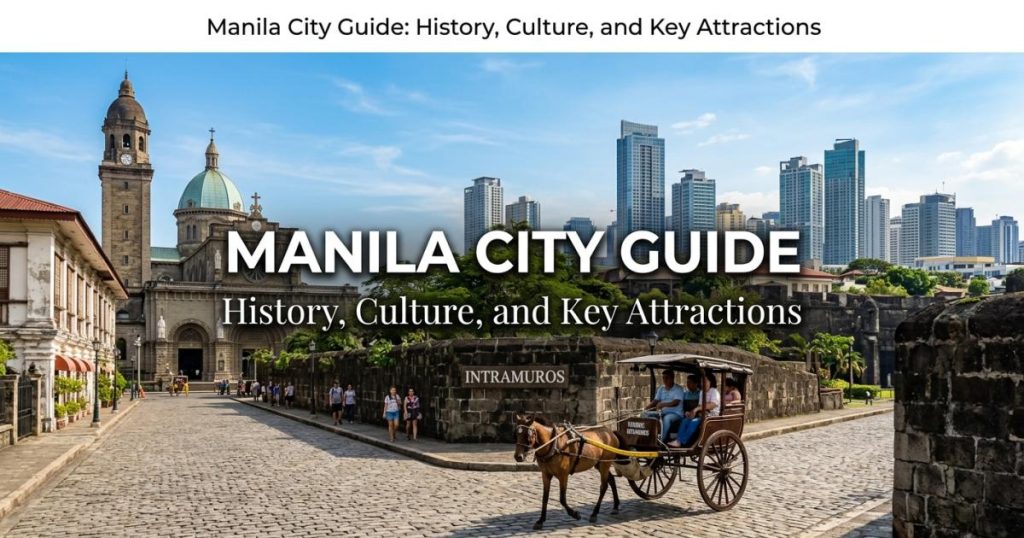
Our manila city guide intramuros explores Spanish and Asian roots, while FBM Play offers a PAGCOR-accredited online gaming option for players 21+ in the Philippines.
Manila blends centuries of Spanish, Chinese, and American influence, creating a distinct cultural landscape. Intramuros stands as its historic walled core, anchoring the city’s rich heritage and providing visitors with a direct look into the architectural and social history of the capital.
Intramuros — The Walled City
Manila’s historic walled core, established in the late 16th century, stands as the center of Spanish colonial rule. Constructed primarily from volcanic tuff and brick, the massive defensive walls were built to protect the administrative seat of the Spanish East Indies from foreign invasions and pirate incursions. Today, Intramuros remains the most historically significant district in the capital.
Key landmarks define the area’s rich architectural heritage:
- Fort Santiago: Situated at the strategic mouth of the Pasig River, this site functioned as a primary defense fortress and served as the prison of national hero Jose Rizal before his execution.
- Manila Cathedral: Characterized by its striking neo-Romanesque facade, this structure has been rebuilt multiple times and serves as the premier church of the Catholic archdiocese.
- San Agustin Church: Officially recognized as the Philippines’ oldest stone church, it features intricate trompe l’oeil ceilings and survived the heavy bombardments of World War II.
- Casa Manila: Located within the Plaza San Luis complex, this museum offers a faithful reconstruction of a 19th-century Spanish colonial mansion to showcase domestic colonial life.
The district is best explored on foot. Walking allows visitors to fully appreciate the cobblestone streets, well-preserved colonial architecture, and the various historical markers detailing the past. Numerous gates, such as Puerta Real and Puerta de Isabel II, offer physical evidence of the engineering methods used during the colonial era.
Malate and Ermita — Culture and Nightlife
South of the walled city are the districts of Malate and Ermita. Before the Second World War, these neighborhoods were the preferred residential areas for the city’s wealthy elite. Following postwar reconstruction, they transformed into Manila’s center for culture, commerce, and tourism.
The western edge of these districts is defined by the Baywalk, a two-kilometer promenade running along Roxas Boulevard. This public space offers unobstructed views of the famous Manila Bay sunset and serves as a central gathering point for residents. Moving inland, the nightlife district along Adriatico Street features a dense concentration of restaurants, cafes, and entertainment venues. This commercial strip sustains the area’s reputation for an active evening economy, drawing both local residents and international visitors.
Ermita and Malate also house important civic institutions. Prominent among these is the Manila Zoo, which holds the title of the oldest zoo and botanical garden in the Philippines. Since opening to the public in 1959, it has maintained collections of endemic Philippine wildlife and serves as an educational facility for schools and families across the metropolitan region.
Binondo — The World’s Oldest Chinatown
Located across the Pasig River from Intramuros is Binondo, officially established by the Spanish colonial government in 1594. Recognized as the world’s oldest Chinatown, this historic district was originally created as a permanent settlement for Catholic Chinese immigrants. Over the centuries, it became the focal point for Manila’s deep Chinese trade and cultural ties.
Binondo remains a highly active commercial center. The district is characterized by narrow, crowded streets lined with wholesale businesses, traditional medicine shops, and hardware suppliers. Ongpin Street functions as the main commercial artery, where the integration of Filipino and Chinese cultures is most visible.
The area is heavily visited for its traditional food establishments. Decades-old eateries serve authentic noodles, dumplings, and baked goods such as hopia. The Binondo Church reflects this cultural fusion with an architecture that incorporates both Catholic and Chinese design elements.

Shopping and Modern Attractions
While the historical districts preserve the capital’s heritage, modern Manila remains the country’s main shopping hub. The city features a wide spectrum of retail environments, from traditional street markets to expansive commercial districts located throughout the metro area.
Districts like Quiapo and Divisoria offer traditional market experiences where textiles, electronics, and local crafts are traded in high volumes. In contrast, the wider metropolitan area is dotted with major malls that function as integrated lifestyle centers. These massive complexes provide air-conditioned environments housing thousands of retail brands, grocery stores, dining halls, and entertainment facilities. This retail infrastructure highlights the rapid commercial development of the capital, existing alongside its centuries-old historical sites.
Gaming Venues in Manila
The Philippine capital features a regulated gaming sector overseen by the Philippine Amusement and Gaming Corporation (PAGCOR). Physical gaming facilities are distributed throughout the city, ranging from standard casino floors to massive integrated resort complexes situated near the Manila Bay area.
For PAGCOR-run Casino Filipino branches and private casino venues in Manila, see FBM Play’s dedicated guides . These specific resources focus entirely on physical properties, providing operational hours, exact locations, and facility details for those looking to visit land-based gaming establishments.
Playing Online With FBM Play
For players who prefer digital access, FBM Play operates as a PAGCOR-accredited online alternative. The expansion of regulated online gaming in the Philippines allows users to participate in gaming activities without traveling to physical casino locations.
FBM Play is accessible via desktop computers and mobile devices, providing flexibility for its users. The platform is available anywhere in the Philippines with internet access, making it a practical option for those who wish to avoid Metro Manila’s traffic congestion or for players residing in distant provinces. Because the platform operates under PAGCOR regulations, it adheres to operational standards designed to ensure fair play, secure transactions, and consumer protection within the digital gaming sector.
FAQ
What is Intramuros?
Intramuros is Manila’s historic walled core, established in the late 16th century. It served as the center of Spanish colonial rule and features well-preserved colonial architecture and historic landmarks.
What is Manila known for historically?
Manila is known for a deep history that blends centuries of Spanish, Chinese, and American influence. The city is home to significant historical sites, including the world’s oldest Chinatown and the defensive fortress of Fort Santiago.
Where can I find casino venues in Manila?
Physical gaming venues, including integrated resorts and Casino Filipino branches, are located throughout the city. For specific details on these physical locations, please refer to our dedicated Manila casino guides.
Is FBM Play licensed by PAGCOR?
Yes, FBM Play is a PAGCOR-accredited online gaming platform. It is legally available to registered players aged 21 and older located anywhere in the Philippines.
FBM Play strictly enforces age verification and encourages all users to practice responsible gaming. Online gaming on the platform is restricted entirely to individuals who are 21 years of age or older.