
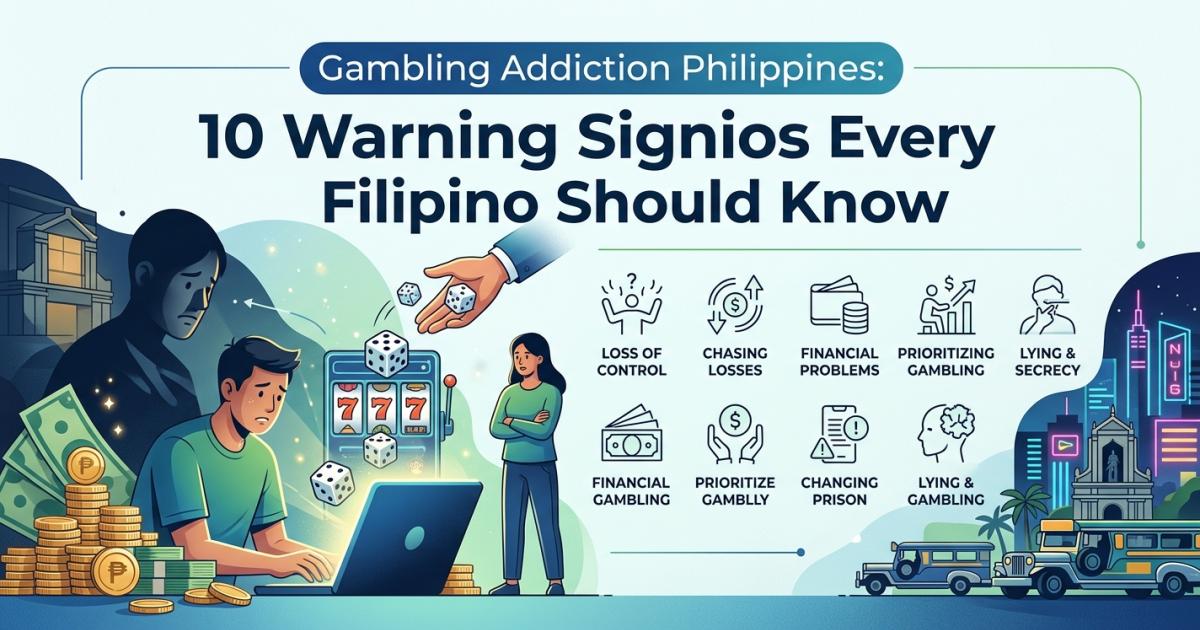
Gambling Addiction Philippines: 10 Warning Signs Every Filipino Should Know
Recognizing gambling addiction Philippines signs is crucial for families. It is a treatable health condition, and players 21+ can get 24/7 help via PAGCOR and FBM Play.
Gambling addiction is a recognized behavioral health condition affecting thousands of Filipino families. Common warning signs include chasing losses, hiding gambling activity, and financial hardship. Filipino players 21+ and families can access 24/7 help through the National Problem Gambling Helpline at (02) 8248-9568.
What Is Gambling Addiction
Gambling addiction, also known clinically as gambling disorder, pathological gambling, or compulsive gambling, is a recognized behavioral health condition. It is officially listed in the DSM-5 as a diagnosable mental health disorder. This condition affects Filipino families across all socioeconomic backgrounds, proving that it does not discriminate based on income, education, or status.
It is vital to understand that developing a gambling problem is not a moral failing or a sign of personal weakness. It involves complex psychological and neurological factors that make it difficult for an individual to control their urges. Fortunately, it is highly treatable with proper professional support, and there is a free 24/7 helpline available directly in the Philippines to assist those in need.
As a progressive condition, gambling addiction typically gets worse over time without intervention. It severely impacts a person's mental, physical, and financial health, while also taking a heavy toll on family members and personal relationships. Early intervention significantly improves the chances of successful recovery, which is why Filipino families are increasingly seeking help to protect their loved ones.
10 Warning Signs of Gambling Addiction
Sign 1: Chasing Losses
- Betting bigger: Increasing wager amounts in a desperate attempt to recover previous losses.
- False beliefs: Holding onto the irrational thought that the next spin or bet will fix everything.
- Emotional betting: Making wagers based on frustration, panic, or anger instead of rational thought.
- Inability to stop: Continuing to play and deposit money even after losing intended amounts.
Sign 2: Using Essential Money
- Rent money: Diverting funds meant for housing to fund gambling activities.
- Food money: Sacrificing grocery budgets for betting.
- Bills money: Ignoring utility payments to pay for spins or wagers.
- Borrowing: Taking out loans or borrowing from loved ones specifically to gamble.
Sign 3: Hiding Gambling Activity
- Lying to family: Being untruthful about the amount of time spent playing.
- Hiding records: Concealing transaction histories from spouses or partners.
- Deleting statements: Erasing bank or GCash statements to hide deposit activities.
- Playing in secret: Waiting until family members are asleep or away to gamble.
Sign 4: Feeling Restless When Not Gambling
- Anxiety: Feeling intense worry or stress when unable to access a gambling platform.
- Irritability: Snapping at family members or friends during breaks from playing.
- Constant thoughts: Obsessively thinking about the next opportunity to gamble.
- Withdrawal symptoms: Experiencing physical or emotional discomfort similar to substance withdrawal.
Sign 5: Gambling to Escape Emotions
- Emotional relief: Playing specifically when feeling sad, angry, or stressed.
- Coping mechanism: Using betting as a primary way to deal with life's difficulties.
- Avoiding reality: Ignoring real-world problems by immersing oneself in gambling.
- Depression: Feeling intense sadness or despair when unable to participate in gambling.
Sign 6: Losing Control Over Time and Money
- Extended sessions: Playing for much longer periods than originally intended.
- Overspending: Consistently betting more money than the planned budget allowed.
- Failed limits: Finding it impossible to stop despite genuinely trying to quit.
- Anxious behavior: Feeling uneasy when attempting to cut back on time or money spent.
Sign 7: Damaged Relationships
- Family conflicts: Experiencing frequent arguments regarding gambling habits or missing money.
- Expressed concern: Having friends or loved ones voice serious worries about your behavior.
- Isolation: Pulling away from social events and loved ones to spend more time gambling.
- Broken promises: Repeatedly failing to keep promises made to family about stopping.
Sign 8: Financial Consequences
- Growing debt: Accumulating significant personal debt directly tied to gambling losses.
- Selling belongings: Pawning or selling personal and family items to fund betting.
- Missed payments: Defaulting on existing loan or credit card payments.
- Legal issues: Facing legal consequences resulting from unpaid gambling debts.
Sign 9: Work or School Problems
- Missing work: Being absent from employment duties to gamble or recover from long sessions.
- Poor performance: Experiencing declining productivity due to tiredness or distraction.
- Job risk: Facing disciplinary action or job loss due to gambling-related issues.
- Dropping grades: For students, seeing a sharp decline in academic performance.
Sign 10: Failed Quit Attempts
- Multiple tries: Having tried to stop gambling several times without success.
- Short-lived success: Being unable to maintain quit attempts for meaningful periods.
- Feeling powerless: Experiencing a complete lack of control against the urge to play.
- Betrayed promises: Feeling guilt over breaking self-promises to never gamble again.
Note: If 3 or more of these signs apply to you or a loved one, consider seeking professional help immediately through the resources listed below.
Gambling Addiction Statistics in Philippines
The current 2026 context in the Philippines reflects a strong push toward consumer protection and responsible gaming. Following the enforcement of the Anti-POGO Act in 2024, the regulatory environment has evolved significantly to protect vulnerable individuals. PAGCOR officially launched the National Problem Gambling Helpline (NPGH) in May 2026, creating a centralized support system. Additionally, platforms enforce stricter age verification, ensuring players are strictly 21+. To further protect consumers, credit cards and cryptocurrency are now banned for gambling transactions.
The support infrastructure has grown to meet the needs of those struggling. The NPGH operates 24/7 with 12 professional counselors working across 3 shifts to ensure free, confidential support is always available. Recognizing the diverse linguistic needs of the country, multiple language support options are provided to ensure clear communication during crisis moments.
The family impact of gambling addiction in the Philippines is profound. It rarely affects just the individual player; it impacts entire families. Spouses and children are typically impacted first, facing emotional distress and instability. Financial hardship then often spreads across extended relatives as the individual borrows money to fund their addiction. Because the family unit is so deeply affected, successful recovery heavily involves family support and education.
How Gambling Addiction Develops
Understanding the progression of gambling addiction helps families identify the problem early. The condition typically develops through four distinct stages.
Stage 1: Winning Phase
- Occasional wins: Early victories create a false sense of excitement and skill.
- Fantasies: The player begins dreaming of winning big and solving all financial issues.
- Increased frequency: Gambling transitions from an occasional activity to a frequent habit.
- Rising stakes: Bet amounts start increasing to maintain the initial thrill.
Stage 2: Losing Phase
- Mounting losses: The inevitable reality sets in as losses begin outweighing wins.
- Chasing behavior: The player starts chasing losses, believing they can win it all back.
- Deception: Lying about gambling activities and hidden losses begins.
- Borrowing: The individual starts borrowing money to continue gambling.
- Withdrawal: The person begins isolating from friends and family members.
Stage 3: Desperation Phase
- Loss of control: The individual can no longer control their gambling behavior.
- Alienation: Severe alienation from family and friends occurs due to broken trust.
- Financial catastrophe: Debts become unmanageable, leading to severe financial distress.
- Desperate actions: The person may resort to legal or illegal actions to secure gambling funds.
- Mental health decline: Severe depression, anxiety, and panic become constant.
Stage 4: Hopeless Phase
- Powerlessness: Feeling completely powerless against the addiction.
- Severe risk: Suicidal thoughts are possible and require immediate crisis intervention.
- Family breakdown: Complete breakdown of marriages and family structures.
- Financial ruin: Total financial devastation, including loss of assets and housing.
- Urgent action: The individual MUST seek help urgently to survive this phase.
It is important to recognize that not everyone reaches Stage 4. Early intervention prevents the worst outcomes, and help is available at every single stage. Recovery is entirely possible with the right support system.
Where to Find Help in Philippines
National Problem Gambling Helpline (NPGH)
Launched on May 26, 2026, by PAGCOR and handled by the Seagulls Flock Organization, the NPGH is the primary resource for immediate assistance.
- Phone: (02) 8248-9568
- Availability: 24 hours, 7 days a week
- Cost: Free and confidential support
- Staffing: 12 trained counselors
What the NPGH provides: Psychological first aid, crisis intervention, guidance and counseling, assessment of gambling severity, triage and referrals, family support, and detailed self-exclusion information.
Gamblers Anonymous Philippines
A fellowship of individuals who share their experience, strength, and hope with each other to solve their common problem.
- Contact: 0915 938 2808
- Website: gaphilippines.com
- Services: Peer support meetings, 12-step recovery program, free anonymous meetings.
Gam-Anon Philippines
A specialized support system dedicated entirely to the loved ones affected by another person's gambling.
- Website: gam-anonphilippines.org
- Services: Support specifically for FAMILY members, group counseling, free anonymous support.
PAGCOR Responsible Gaming Office
The regulatory body providing official oversight and structural support for problem gamblers.
- Services: Handles official complaints, coordinates nationwide self-exclusion, provides regulatory guidance.
- Contact: Accessible via pagcor.ph
How to Support a Loved One with Gambling Addiction
For family and friends navigating this difficult situation, knowing how to act is crucial for both the addicted individual's recovery and your own well-being.
Do:
- Show empathy: Approach the situation with empathy, not judgment or anger.
- Educate yourself: Learn about gambling addiction as a mental health condition.
- Suggest help: Gently suggest professional help and provide helpline numbers.
- Set boundaries: Establish strict financial boundaries to protect yourself and your family.
- Seek support: Contact Gam-Anon Philippines for your own emotional support.
- Encourage exclusion: Help them navigate the self-exclusion process.
- Maintain hope: Keep hope alive for their eventual recovery.
Do NOT:
- Blame or shame: Avoid attacking their character, which can drive them to gamble more.
- Bail them out: Do not pay off their gambling debts, as this enables the addiction.
- Ignore it: Do not ignore the problem hoping it naturally disappears.
- Argue during urges: Avoid intense arguments when they are experiencing strong cravings.
- Handle it alone: Do not try to fix the situation without professional guidance.
- Take the blame: Never feel responsible for their choices or behavior.
Family-specific resources include Gam-Anon Philippines (gam-anonphilippines.org), individual family counseling, specialized support groups for family members, and financial planning services for affected families.
PAGCOR-Mandated Responsible Gambling Tools
All PAGCOR-licensed platforms, including FBM Play, are required to offer strict responsible gambling tools to protect consumers.
- Deposit Limits: Players can set daily, weekly, or monthly caps on deposits. This prevents overspending and keeps control in the player's hands. Notably, INCREASING a limit requires a mandatory cooling-off period.
- Session Time Limits: Users can set a maximum time per session, or a daily/weekly/monthly total time limit. Once reached, the system triggers an auto-logout, supported by ongoing reality check notifications.
- Bet Limits: Players can set a maximum bet per game, which actively prevents impulsive big bets during emotional moments.
- Self-Exclusion: A voluntary account access block is available. Options range from 24h, 7d, 30d, 6mo, 1yr, 3yr, to lifetime. This applies to FBM Play, with PAGCOR-wide exclusion also available.
- Reality Check Notifications: Periodic session updates appear on screen, showing exact time and money spent. These cannot be dismissed without reading and are fully available on FBM Play.
Steps to Take If You Notice Gambling Addiction Signs
For yourself:
- Talk to someone you trust: Reach out to a family member, friend, or counselor. Do NOT try to handle this burden alone.
- Contact NPGH helpline: Call (02) 8248-9568 for free, confidential support available 24/7.
- Set immediate protections: Enable FBM Play self-exclusion, give control of your finances to a trusted family member, and delete all gambling apps from your devices.
- Seek professional counseling: Engage in individual therapy or group counseling, specifically considering gambling-specific therapy.
- Attend Gamblers Anonymous: Join peer support meetings and follow the 12-step program through free confidential meetings.
- Support financial recovery: Work with a financial counselor to create a debt management plan and receive budgeting support.
- Focus on healthier alternatives: Redirect your energy into sports, hobbies, time with loved ones, or learning new skills.
For someone you love:
- Learn about gambling addiction: Understand the psychology behind their behavior.
- Contact Gam-Anon Philippines: Get support from others who understand what you are going through.
- Approach with empathy: Speak to them calmly and without accusations.
- Offer specific support: Provide them directly with the NPGH helpline number.
- Set personal boundaries: Protect your own finances and emotional well-being immediately.
- Attend family counseling: Seek professional mediation if possible.
- Maintain hope: Support their journey while acknowledging recovery takes time.
FBM Play Responsible Gambling Commitment
FBM Play strictly implements all PAGCOR-mandated responsible gambling tools to ensure a safe environment for consumers.
For all Filipino players 21+, FBM Play ensures deposit limits and session time limits are readily available. Players can access self-exclusion ranging from 24 hours to a lifetime ban. The platform issues mandatory reality check notifications, enforces strict 21+ KYC verification, and prominently displays National Problem Gambling Helpline links.
For new Filipino players 21+, FBM Play structures its welcome offers to encourage low-risk participation rather than heavy spending. New players receive a 20p no deposit bonus, keeping initial risk very small. Additional structured rewards include a first deposit bonus up to ₱1,000, 3 days cashback up to ₱7,500, a total deposit wheel up to ₱15,780, and a daily login Free Spin. The total new player rewards can reach up to ₱24,280. Players can make GCash deposits from just 10p, with withdrawals processed in 1-5 minutes. This small deposit minimum actively prevents large impulsive spending by allowing players to enjoy the platform without committing large sums of money.
FAQ
What are the signs of gambling addiction?
Common warning signs include chasing losses, hiding gambling activities, and using essential money for betting. It often leads to damaged relationships, severe emotional distress, and significant financial hardship.
Where can I get help for gambling addiction in the Philippines?
You can call the National Problem Gambling Helpline at (02) 8248-9568 for free, confidential 24/7 support. Additionally, Gamblers Anonymous offers peer support meetings and can be reached at 0915 938 2808.
How do I help a family member with gambling addiction?
Approach them with empathy rather than judgment, gently encourage professional help, and set strict boundaries to protect your own finances. Family members should also seek their own support through Gam-Anon Philippines at gam-anonphilippines.org.
Responsible Gambling Reminder: Gambling should be viewed as a form of entertainment, not a way to make money. Always play within your limits. Strictly for players 21 and above.