

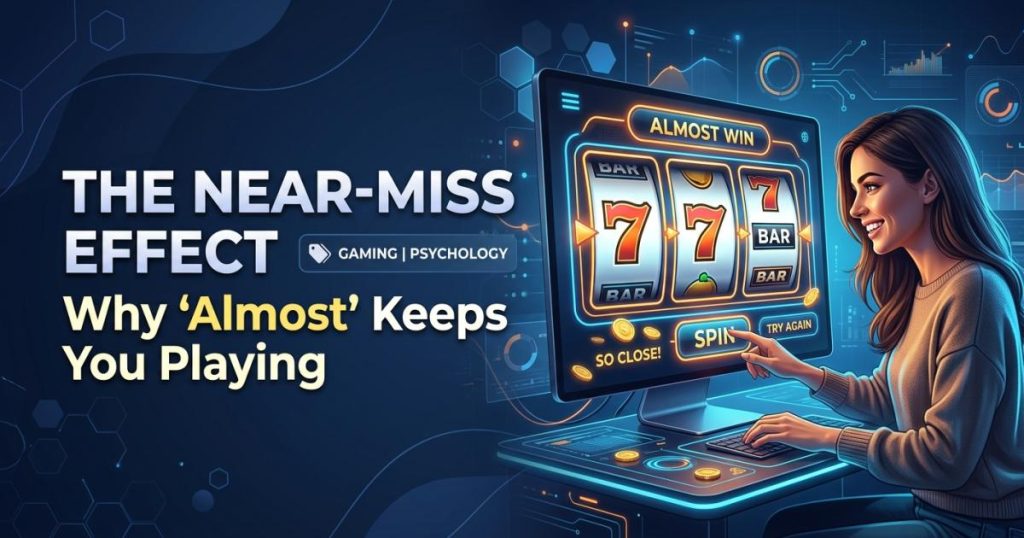
For Philippines players 21+ on PAGCOR-licensed platforms such as FBM Play, the near miss effect describes a close loss that may encourage play but cannot predict the next result.
What a Near Miss Is
A near miss is a losing result that comes close to a win. The outcome can look as if success was just one symbol, number, or step away, even though nothing was won.
- Matching symbols: Two matching symbols appear while the third stops just off the payline.
- Scatters: Two Scatters appear when three are needed to activate a feature.
- Numbers: A number appears next to the one selected.
The important distinction is simple: a near miss is still a loss. It only looks close because the result resembles a winning arrangement. The appearance of closeness does not change the outcome or provide information about what will happen next.
People may describe this experience in everyday terms such as, “That was almost a win.” In responsible gambling education, the useful response is to separate the feeling of proximity from the fact of the result: the round ended without a win.
What the Research Found
The findings below come from laboratory studies. They describe results from controlled tasks and group averages, not what every person will feel during real play.
Clark and colleagues, 2009
In Clark and colleagues’ 2009 laboratory study, published in Neuron, volunteers played a simulated slot machine task. The volunteers rated near misses as less pleasant than other losses, yet near misses increased their desire to play.
The increase appeared on rounds where the player felt in control of arranging the gamble. This finding describes the participants’ responses in that experimental setting; it does not establish that every near miss produces the same reaction.
Brain scans in the same study showed that near misses activated the ventral striatum and the anterior insula. These areas also responded to monetary wins in the task. This does not mean that a near miss was a win; it shows that some brain responses overlapped with responses observed after wins.
Chase and Clark, 2010
Follow-up laboratory work by Chase and Clark in 2010 found that, among regular gamblers, higher gambling severity was linked to a stronger midbrain response to near misses. The result was a group-level association in an experimental study, not a diagnosis or a prediction about any individual.
Sescousse and colleagues, 2016
Sescousse and colleagues reported in 2016 that people with gambling disorder showed amplified striatal responses to near misses compared with a control group. This comparison concerns the groups studied in the laboratory and should not be used to label or assess a reader.
How often near misses occurred in experiments
Laboratory studies that varied how often near misses occurred found that persistence peaked at a moderate rate, around 30% in the studies reviewed. That figure describes experimental tasks, not any real game, including games available through FBM Play.
These studies have clear limits. They used laboratory tasks, simulated activities, scans, questionnaires, and group comparisons. They do not show what any one person will feel in any particular game, and they do not show how often near misses occur on a real platform. For general information about licensed play, users can review the operator information available through fbmplay.com and PAGCOR.
Why a Near Miss Is Not “Closer to Winning”
Each spin or round is a separate random event. How the symbols landed on the last spin does not change the next one, so a near miss does not make a win more due or more likely.
A near miss can feel like progress because the result resembles a winning arrangement. That impression is not a probability signal. It tells you nothing about what comes next, and no pattern from previous outcomes is a reliable way to predict the next result.
This is the same reason that a previous result cannot create a debt, an opportunity, or a correction in the next round. For a plain-language explanation of this reasoning, see the gambler’s fallacy explained and how casino win rates work.
How It Shows Up in Real Play
In discussions of near miss gambling, people commonly describe thoughts that connect a close loss with a reason to continue. These thoughts can be noticed without judging the person who has them.
- Feature expectation: “Two Scatters, one more and I’d have had the feature.”
- Immediate continuation: “That was so close, one more spin.”
- Bet escalation: Raising a bet or playing longer after a near miss to catch the win that felt close.
These statements describe a feeling of unfinished progress, not evidence that a win is approaching. A person may continue for many different reasons, and a single thought or action does not establish a problem.
How to Notice It and Step Back
A practical response is to create distance between the result and the next decision. The following steps are intended as neutral safeguards, not as a promise that understanding near misses removes the risk of losing money.
- Name the result: Say, “That was a loss, and it only looked close.” This keeps the outcome separate from the emotional impression.
- Pause: Wait before the next spin after a near miss. Take a break if you notice an urge to go again immediately.
- Keep bets separate: Do not size a bet by how close the last result looked. The last outcome does not supply a reason to increase or change the next bet.
- Choose limits in advance: Use a loss limit and a session-time limit before play begins. See the FBM Play loss limits guide and FBM Play session time limits.
- Set a budget: Decide how much money can be spent before starting, using a gambling budget guide. Do not treat a near miss as a reason to add funds.
Limits work best when they are decided before the feeling of “almost” appears. Understanding the effect may help someone identify a decision point, but it does not improve winning chances and does not remove the possibility of losing money.
If “Almost” Is Driving How Long You Play
Consider whether the feeling of being close is deciding how much or how long to play. For example, repeated increases in time or spending after close losses may be a reason to pause and read the signs of problem gambling.
This is not a diagnosis. It is an invitation to use support and practical controls when gambling decisions no longer feel comfortably within planned limits.
Self-exclusion information is available through FBM Play self-exclusion. The National Problem Gambling Helpline in the Philippines, (02) 8248-9568, is open 24/7 and is available at any time for support.
FAQ
What is the near-miss effect?
It is the experience of a losing result that feels close to a win and, in laboratory studies, increased the desire to keep playing. It does not change the result or predict the next one.
Why do near misses feel like wins?
Laboratory research found that near misses activated the ventral striatum and anterior insula, areas that also responded to monetary wins in the study. A similar response does not make the near miss a win.
Does a near miss mean a win is about to come?
No. Each spin or round is a separate random event, so the previous result carries no information about the next result.
Is a near miss a sign that a game is rigged?
A near miss alone does not show that a game is fair or unfair. Check the operator’s license instead using a legitimate gaming checklist.
How can I stop a near miss from making me play more?
Name it as a loss, pause before the next round, and use a budget, loss limit, and session-time limit set in advance. If “almost” is controlling your spending or time, consider self-exclusion or call the National Problem Gambling Helpline at (02) 8248-9568.
Responsible gambling means treating every result as separate, staying within a planned budget, and taking a break when play no longer feels within your limits. FBM Play is for users aged 21+; check PAGCOR requirements and seek support through the PAGCOR Helpline at (02) 8248-9568 when needed.