

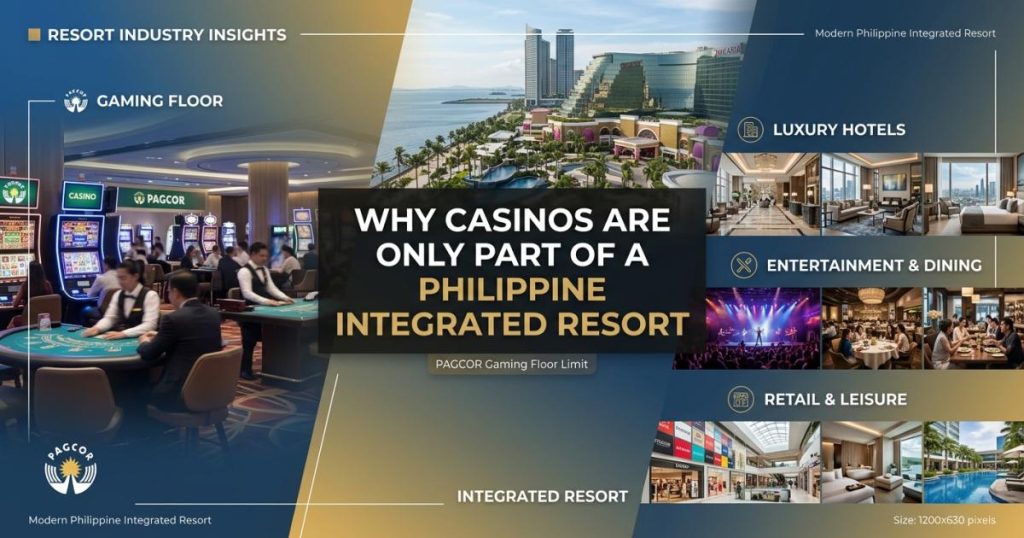
The PAGCOR gaming floor limit restricts Philippines integrated resorts to 7.5% gaming space, giving 21+ players context on physical venues versus online options like FBM Play.
The 7.5% Gaming Floor Rule
The Philippine Amusement and Gaming Corporation (PAGCOR) enforces a strict spatial regulation for large-scale resort developments across the country. Under this regulatory framework, developers building an integrated resort are mandated to allocate no more than 7.5% of their total facility floor area to actual gaming operations. This means that out of the entire massive footprint of a licensed property, the casino floor itself occupies a relatively small fraction of the available square footage.
The remaining 92.5% of the property must be dedicated entirely to non-gaming facilities. This vast majority of the floor space is reserved for amenities that drive broader tourism and hospitality goals. To comply with this regulation, resort developers build extensive hotel towers, sprawling luxury retail boulevards, massive dining complexes, and varied entertainment attractions.
- Hotel Accommodations: Properties must provide thousands of rooms across different tiers, from standard guest rooms to luxury suites, taking up a significant portion of the non-gaming floor area.
- Retail and Shopping: The 92.5% requirement often includes expansive malls featuring international luxury brands and local boutiques.
- Dining Facilities: Dozens of restaurants, ranging from casual food courts to fine dining establishments led by international chefs, contribute to the non-gaming space.
- MICE Venues: Meetings, Incentives, Conferences, and Exhibitions (MICE) facilities require massive square footage, including grand ballrooms and convention halls.
- Entertainment Attractions: Indoor beach clubs, theaters, art installations, and family-friendly zones are built to satisfy the non-gaming mandate.
This structural requirement ensures that the physical footprint of the casino remains secondary to the overall resort experience. Regulatory compliance is checked closely during the architectural planning and construction phases. Developers must submit detailed floor plans proving that the gaming area will not exceed the 7.5% threshold before they can receive their final operational licenses.
Why PAGCOR Set This Limit
The underlying philosophy behind this spatial restriction is to ensure that these massive developments function primarily as comprehensive tourism destinations rather than standalone casinos. PAGCOR Assistant VP Ma. Vina Claudette Oca has stated this requirement is a deliberate policy choice to position gaming as just one component of a much larger hospitality and tourism offering.
By forcing developers to invest heavily in non-gaming infrastructure, the regulatory body guarantees that the economic benefits of the property extend far beyond gambling revenues. When a company is required to build a massive hotel and convention center just to operate a casino, the resulting property creates thousands of jobs across multiple sectors. Culinary professionals, retail workers, event organizers, and hotel staff are all required to operate the 92.5% of the property dedicated to non-gaming activities.
Furthermore, this policy helps diversify the target demographic for these properties. While the gaming floors are highly regulated spaces restricted to patrons who are 21 and older, the vast majority of the integrated resort is open to all ages. This allows the properties to market themselves as family-friendly vacation destinations, corporate event hubs, and luxury shopping centers.
The regulatory framework also protects the local market by ensuring that new developments bring substantial foreign direct investment into the country’s physical infrastructure. The capital required to build the non-gaming components is massive, meaning only serious developers with the capacity to boost the national tourism profile can enter the market. This barrier to entry prevents the proliferation of small, gaming-only venues in designated tourist zones, maintaining the high-end appeal of the integrated resort model.
What “Integrated Resort” Means in the Philippines
In the context of Philippine gaming and hospitality regulations, an “integrated resort” is a specific legal and structural classification. This classification applies to major properties located in Entertainment City—a massive gaming and entertainment complex situated in Parañaque, Metro Manila—as well as other similar PAGCOR-designated zones across the country.
Properties that fall under this classification include massive developments like Solaire Resort and Casino, and Okada Manila. These venues are built on sprawling plots of land and represent billions of dollars in investment. The defining characteristic of these properties is their compliance with the 7.5% gaming floor rule, meaning their identity is tied just as much to their hotels, theaters, and restaurants as it is to their casino operations.
It is important to distinguish these integrated resorts from standalone Casino Filipino branches. Casino Filipino is a brand operated directly by PAGCOR. These state-run branches are often located in leased spaces within existing hotels or commercial buildings. Because they are standalone gaming venues operated by the regulator itself, Casino Filipino branches do not operate under the same floor-area structure required of private integrated resort developers.
The integrated resort model is designed to be a self-contained ecosystem where a tourist could spend several days without ever leaving the property. A guest might attend a convention in the morning, shop at luxury boutiques in the afternoon, dine at a high-end restaurant in the evening, and visit the casino at night. The strict floor area regulations are what physically force this ecosystem into existence, separating the Philippine integrated resort model from traditional standalone gambling halls found in other jurisdictions.
How This Supports Tourism Growth
The mandate to build extensive non-gaming facilities has proven to be a highly effective strategy for national economic development. PAGCOR has consistently cited integrated resorts as a key driver of Philippine tourism recovery and long-term growth. The success of this model is reflected in the financial data, with total gaming and entertainment revenue in the country rising from $3.75 billion in 2022 to an estimated $6.5 billion in 2024.
While the gaming floors generate significant tax revenue, the non-gaming majority of these properties contributes heavily to broader economic activity. The 92.5% of the floor space dedicated to other amenities draws a diverse array of international and domestic tourists who might not have visited the country solely for gaming.
- International Conventions: The massive MICE facilities required by the floor-area rules allow the Philippines to host major international summits, trade shows, and corporate events, bringing in thousands of business travelers.
- Retail Tourism: The luxury shopping boulevards attract high-net-worth individuals from across Asia, boosting retail sector revenues and creating jobs for local sales professionals.
- Culinary Tourism: By mandating extensive dining options, integrated resorts have elevated the local culinary scene, attracting international restaurant brands and providing a platform for local chefs.
- Entertainment Sector Growth: The construction of large-scale theaters and arenas within these resorts has made the Philippines a regular stop for international touring artists and major theatrical productions.
This diversification means the local economy is not solely dependent on casino revenues. Even during periods when gaming volume fluctuates, the hotels, restaurants, and retail spaces continue to generate income and sustain employment. The regulation effectively uses the high profitability of the 7.5% gaming area to subsidize and mandate the construction of the 92.5% non-gaming infrastructure, creating a robust, multi-faceted tourism product that competes with other major destinations in the Asia-Pacific region.
FAQ
How much floor space can a Philippine integrated resort use for gaming?
PAGCOR mandates that integrated resorts allocate no more than 7.5% of their total facility floor area to gaming operations. The remaining 92.5% must be dedicated to non-gaming facilities like hotel rooms, retail areas, and dining.
Why does PAGCOR limit gaming floor area in integrated resorts?
PAGCOR Assistant VP Ma. Vina Claudette Oca has stated this requirement ensures integrated resorts function as broader tourism destinations rather than standalone casinos. The policy positions gaming as just one component of a larger hospitality and tourism offering.
What’s the difference between an integrated resort and a Casino Filipino branch?
Integrated resorts are massive private developments in designated zones that must follow the 7.5% gaming space rule and include extensive non-gaming attractions. In contrast, Casino Filipino branches are standalone gaming venues operated directly by PAGCOR without this same floor-area structure.
Does this floor-area rule apply to online platforms like FBM Play?
No, this spatial regulation applies exclusively to physical integrated resorts and their physical land development. Online platforms such as FBM Play operate under different digital regulatory frameworks without physical floor space requirements.
Understanding these physical zoning regulations provides transparency into how the Philippine gaming industry is structured to support national tourism. Please remember that gaming inside these physical integrated resorts, as well as on regulated online platforms, is strictly restricted to individuals who are 21 and older. Always practice responsible gambling and play within your limits.