

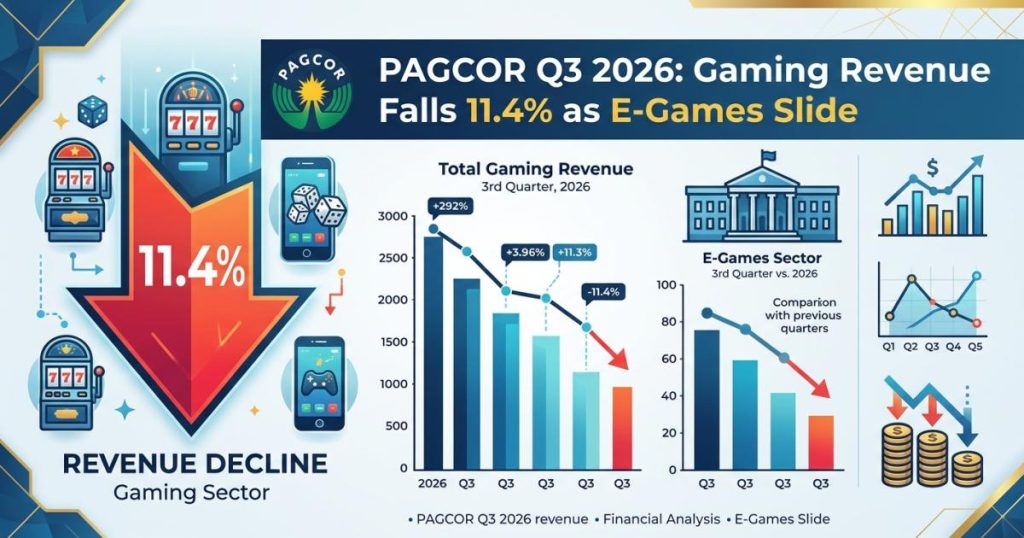
The pagcor q3 2026 revenue report shows Philippines gaming revenue fell 11.4% to ₱83.72 billion due to e-games; FBM Play is a PAGCOR-licensed platform for players aged 21+.
By Michael (News & Updates) — The figures cover the quarter ended September 30, 2026, and were officially reported in November 2026. The data highlights a notable shift in market dynamics, primarily driven by the online sector’s performance over the past year.
Q3 2026 at a Glance
Philippine gross gaming revenue fell 11.4% year on year to ₱83.72 billion in Q3 2026, according to PAGCOR. This result contrasts with the rapid expansion observed in previous reporting periods. According to a November 6, 2026 report by World Casino News, the total Q3 GGR was also 5% lower than Q2 2026, indicating consecutive quarterly contractions. For context on the preceding quarter, readers can review PAGCOR’s Q2 2026 results.
The third-quarter figures provide a clear picture of how different segments are adapting to current economic conditions. The table below outlines the specific gross gaming revenue performance across the industry’s main segments.
| Segment | Q3 2026 GGR | Q3 2025 GGR | Change | Share of total |
|---|---|---|---|---|
| Total industry | ₱83.72 billion | ₱94.51 billion | −11.4% | 100% |
| Licensed commercial casinos | ₱45.38 billion | ₱45.56 billion | −0.4% | about 54.2% |
| Electronic gaming (e-games, e-bingo, licensed bingo) | ₱35.28 billion | ₱45.73 billion | about −23% | about 42.1% |
| PAGCOR-run Casino Filipino | ₱3.03 billion | ₱3.18 billion | −4.8% | about 3.6% |
Electronic Gaming Drives the Decline
Electronic gaming revenue fell about 23% to ₱35.28 billion in Q3 2026, while licensed casinos were almost flat. This online segment, which includes e-games, e-bingo, and licensed bingo, lost ₱10.45 billion year on year. A November 6, 2026 statement covered by the Manila Bulletin highlights that this reduction accounts for most of the industry’s total drop.
Despite this sharp decrease, electronic gaming still made up more than 40% of all gaming revenue in Q3. Meanwhile, licensed commercial casinos saw a very slight dip of −0.4%, remaining relatively stable. This stark difference between physical venues and online platforms highlights the core area of the philippine gaming revenue 2026 contraction.
Is the Decline Slowing?
The Q3 2026 decline was smaller than Q2’s 20.3% drop. While the pagcor e-games revenue is lower than the previous year, this deceleration suggests the market may be finding a new baseline. Industry analysts are closely monitoring these quarter-over-quarter shifts to determine if the market has fully absorbed recent economic and regulatory shocks.
PAGCOR Chairman Alejandro Tengco addressed these figures during the November report. He called the slower pace of decline in the third quarter “an encouraging development.” This perspective follows a warning Tengco issued earlier in June, where he stated that full-year GGR could fall by as much as 19%.
Why Revenue Fell
PAGCOR links the weakness to inflation and geopolitical uncertainty. Specific international issues, including Middle East tensions, have impacted the broader economic environment. These economic pressures have forced many individuals to prioritize essential goods, subsequently reducing consumer spending on discretionary activities.
Additionally, regulatory shifts have played a significant role. In August 2025, the Bangko Sentral ng Pilipinas ordered e-wallets to remove in-app links to gambling sites. Major financial applications, including GCash and Maya, removed them from August 16, 2025. Tengco has previously noted that having e-wallet gambling links removed contributed heavily to the weaker online gaming revenue.
PAGCOR’s Own Revenue: Nine-Month Figures
It is essential to distinguish between the industry’s gross metrics and the regulator’s income. GGR is what the whole industry earns from bets; PAGCOR revenue is what PAGCOR itself collects from regulatory fees and its own operations. This distinction is vital for understanding the financial health of the regulatory body versus the operational scale of the licensed platforms. A November 3, 2026 report by World Casino News detailed the agency’s nine-month financials.
The data below illustrates the pagcor revenue drop independently from the wider market gross metrics. This trend aligns with PAGCOR’s earlier income drop reports from previous months.
| Item | January–September 2026 | Change |
|---|---|---|
| PAGCOR total revenue | ₱64.41 billion | −23.41% |
| PAGCOR revenue from electronic gaming | ₱27.63 billion (from ₱44.03 billion) | −37.23% |
Context: A Record 2025
To fully grasp the current philippines online gaming decline, it helps to view the numbers against the previous year’s historic highs. In 2025, Philippine GGR hit a record ₱396.14 billion. The market experienced unprecedented growth during that twelve-month period, setting a high baseline that has proven difficult to maintain amid changing economic realities.
During that time, online gaming generated ₱201.12 billion, which represented 50.77% of the total industry revenue. This marked the first time the online sector overtook physical casinos. The pagcor ggr third quarter results for 2026 reflect a market adjusting after that massive peak.
What’s Next
The regulatory and fiscal landscape may see further adjustments in the near future. A November 9, 2026 report by iGaming Expert indicated that the Department of Finance is considering a tax on online gaming. However, no specific details regarding this potential tax have been confirmed, and stakeholders are awaiting further announcements.
PAGCOR is targeting December 2026 to launch an app for verifying licensed online gaming platforms. As noted by Focus Gaming News in October 2026, this upcoming PAGCOR’s verification app is designed to help users easily identify regulated operators in the market.
What This Means for Players
These broader pagcor q3 2026 revenue figures do not change the rules for players participating in the regulated market. Licensed platforms such as FBM Play continue to operate strictly under PAGCOR rules. These regulations require that all users be 21+ and complete full KYC verification before any deposits are made. You can learn more about responsible gaming on FBM Play to understand these ongoing protections.
Players should use only PAGCOR-licensed sites to ensure a regulated environment. Users can check the official registry at pagcor.ph/pagcorguarantee, and utilize the upcoming verification application once it is launched. For specific platform details, you can review FBM Play’s PAGCOR license.
Furthermore, due to the regulatory changes from 2025, deposits now go directly through the platform’s own cashier systems, rather than relying on e-wallet in-app links.
FAQ
1. How much did Philippine gaming revenue fall in Q3 2026?
Philippine gross gaming revenue fell 11.4% year on year to ₱83.72 billion in the third quarter of 2026, per PAGCOR. The total was also 5% lower than the preceding quarter.
2. Why did PAGCOR e-games revenue drop?
PAGCOR cites weaker consumer spending driven by inflation and geopolitical uncertainty. Additionally, the 2025 removal of e-wallet gambling links weighed heavily on the online gaming sector’s performance.
3. Is online gaming still legal in the Philippines?
Yes, online gaming remains fully legal in the Philippines. It is permitted exclusively on PAGCOR-licensed platforms for players aged 21 and older.
4. When will PAGCOR’s verification app launch?
PAGCOR is targeting December 2026 to launch its new application. This tool will help players verify licensed online gaming platforms easily.
While the pagcor q3 2026 revenue reports show a market in transition, regulated operations continue steadily. FBM Play is for players aged 21+ only. PAGCOR National Problem Gambling Helpline: (02) 8248-9568, 24/7.